
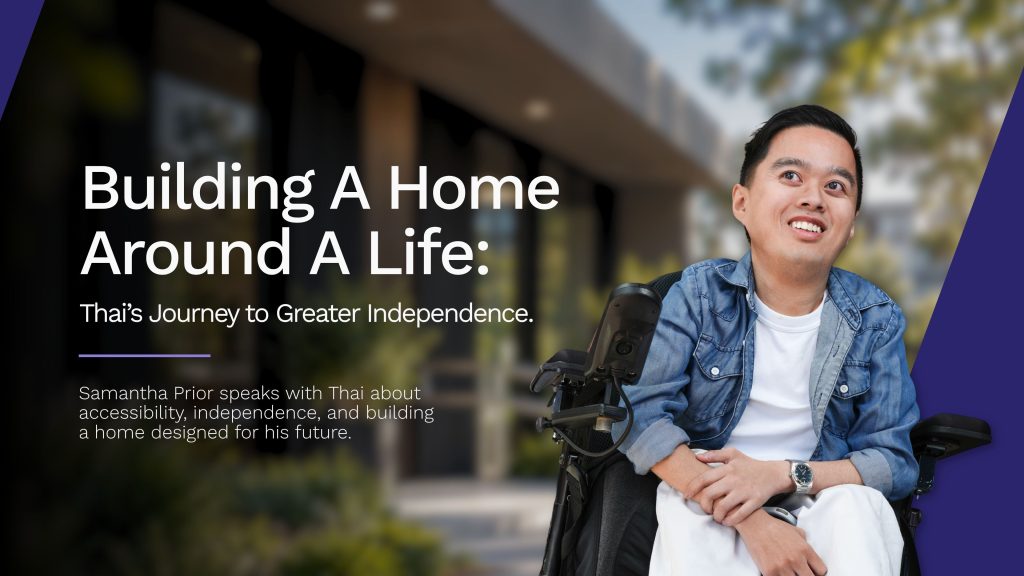
Samantha Prior speaks with Thai about accessibility independence and building a home designed for his future
Finding the right home can change far more than where someone lives. When a home is designed around the person who will live there, it can create greater privacy, certainty and control over everyday life.
As someone who has experienced the Specialist Disability Accommodation journey myself, I understand how difficult it can be to find clear information and people you trust. The process asks people with disability and their families to make significant decisions while navigating funding, assessments, design standards and unfamiliar terminology.
Thai knows that complexity well. He lives with congenital muscular dystrophy, uses a powered wheelchair and has spent much of his life adapting to environments that were not designed for him. Now, with support from Empowered Housing and Empowered Liveability, he is building a home that reflects his routines, ambitions and changing needs.
Thai is an engineer at Deloitte, where he works across engineering, cloud, data and artificial intelligence projects. He also leads Deloitte Asia Pacific’s Accessibility and Inclusion Employee Resource Group and contributes his lived and professional experience to disability advocacy, research and community initiatives.
I spoke with Thai about his housing journey, the decisions behind his accessible design and what owning a home will mean for the life he wants to continue building.
Samantha: Before we talk about the house, can you tell us a little about yourself and the life you enjoy?
Thai: I’m from Melbourne and have lived with congenital muscular dystrophy my entire life. I use a powered wheelchair. Professionally, I’m an engineer at Deloitte, working across engineering, cloud, data and AI projects for enterprise organisations. I also lead Deloitte Asia Pacific’s Accessibility and Inclusion Employee Resource Group. That role allows me to bring together my professional and lived experience to advocate for accessibility and help create workplaces where people with disability can genuinely thrive.
I’m also involved in disability advocacy and volunteering with organisations including Summer Foundation, Physical Disability Australia and Muscular Dystrophy Australia. Outside work and advocacy, I’m passionate about photography and technology. I love gaming, basketball, music, movies, nature and spending time with family and friends.
Living with muscular dystrophy affects how I do many things, but I’ve never wanted it to define who I am or what I aspire to achieve. I’m an engineer, photographer, friend, family member and advocate. Like anyone else, I have a career I want to grow, interests I care about and things I still want to experience.
Samantha: How did you first learn about Specialist Disability Accommodation, and was the pathway easy to understand?
Thai: My understanding of SDA developed as I became more involved with the NDIS and began thinking seriously about what long-term independence could look like for me.
At first, the pathway was not easy to understand. SDA is a specialised part of an already complex system. You encounter terminology about eligibility, design categories, funding, occupational therapy assessments, functional capacity, home and living supports, providers and evidence. It can be overwhelming, particularly when you are also making some of the biggest decisions of your life.
With the right people around me, I began to understand that SDA was not simply about finding a more accessible building. It could create an environment that gave me greater choice and control. Instead of asking, ‘What house can I fit into?’ I started asking, ‘What kind of home will allow me to live the life I actually want?’
That changes the conversation. You begin thinking about where you want to live, how you work, who you want to invite over, how support workers will operate within the home, what technology could increase your independence and how the house might adapt as your needs change.
Samantha: What has the experience of designing and building your own accessible home been like?
Thai: It has been one of the most exciting, challenging and meaningful things I’ve undertaken. A genuinely accessible home involves details that many people may never have to consider. The position of a switch, power point, doorway, bench, control or piece of equipment can determine whether I can do something independently or need someone else’s assistance.
Because muscular dystrophy is progressive, I’ve also had to think beyond what I need today. I’m designing a home that I hope will continue to work for me in five, ten or twenty years.
The circulation spaces need to accommodate my powered wheelchair comfortably, and the home needs to be step-free. We have considered how bathrooms and other functional areas work with the way I move and receive support, as well as higher ceilings and the potential for ceiling-hoist infrastructure if I need it in the future.
Smart-home technology is another important part of the design. Being able to control lighting, doors, blinds, temperature and entertainment independently might sound like convenience to somebody else. For me, it can mean not having to call someone into the room whenever I want to change something in my own environment. That is privacy, choice and independence.
Samantha: Did accessibility mean compromising the way you wanted your home to look and feel?
Thai: I did not want to build a collection of disability features. I wanted a beautiful home that happened to be exceptionally accessible. I want spaces where I can work, create, spend time with friends and family and pursue the things that make life meaningful to me.
There have been practical compromises. Every building project has budgets, engineering requirements, regulations and physical constraints. But the underlying vision has never been compromised. The goal was not simply to build a house I could access. It was to build a home in which I could build a life.
Samantha: What do you think it will feel like when you finally receive the keys?
Thai: I think it will be emotional. There will be excitement and probably relief after all the planning, meetings, paperwork, decisions and challenges. But I don’t think the most meaningful moment will be receiving the keys. I think it will be everything that happens afterwards.
It will be waking up in a space designed with me in mind, controlling my environment independently and working from home without unnecessary barriers. It will mean having friends and family over without first wondering whether the space will work for me, and having support workers able to assist me safely and comfortably.
Those moments might sound ordinary, but that is why they matter. Independence does not mean doing everything yourself. It means having the right environment, technology, people and support around you so that you have genuine choice and control over your life.
Home ownership also brings certainty. It is knowing I have somewhere I can build my future, somewhere that can adapt as my needs change and somewhere I can continue my career, pursue my passions, maintain relationships and create memories without wondering whether the next stage of my disability will mean starting over somewhere else.
Success will be when the house stops feeling like an ‘accessible house’ and simply becomes home.
Samantha: How did inaccessible housing and limited support affect you and your family before the NDIS?
Thai: Before I experienced genuinely accessible housing and the support I have today, I did not fully appreciate how much energy my family and I spent adapting our lives around environments and systems that were not designed for me.
When you have lived with disability your whole life, you become very good at adapting. You find another way, plan ahead, avoid certain places or accept that things take longer. Eventually, many of those adjustments feel normal.
My family has supported me physically, advocated for me and helped me navigate healthcare and disability systems. Before the NDIS, families often carried an enormous responsibility. I am incredibly grateful for everything my family has made possible, but I have also learnt that independence and family support are not opposites. Becoming more independent does not mean I love or need my family less. It means our relationship does not have to be defined primarily by what they need to do for me physically.
Support workers, allied health professionals, assistive technology and accessible housing have allowed me to challenge myself and make decisions increasingly on my own terms. The right support creates independence. It gives someone the freedom to build a life, rather than simply helping them get through the day.
Samantha: Has working with Empowered Housing and Empowered Liveability made the process easier?
Thai: Absolutely. Accessible housing is deeply personal. The people involved are not simply designing rooms or meeting technical standards. Their decisions affect how independently someone can live, how safely they receive support and whether the home will continue to work as their needs change.
What I have appreciated is being able to talk about what I want my life to look like, rather than approaching every decision through minimum accessibility requirements. There is an enormous difference between asking, ‘Does this meet the standard?’ and asking, ‘Will this work for Thai?’
No two people with disability are identical. We have different bodies, routines, support needs, personalities, careers, families, hobbies and aspirations. A technically accessible home can still be the wrong home if nobody has taken the time to understand the person who will live there.
The right team also does not simply agree with everything. A good team listens, asks questions, explains what is possible, challenges an idea when necessary and works with you to find another way to achieve the underlying goal. That support and expertise have helped me make better decisions while keeping ownership of my journey.
Samantha: What do you wish more people understood about living a good life with a physical disability?
Thai: Most people with physical disability want many of the same things everybody else wants. We want somewhere that feels like home, meaningful work, relationships, privacy, interests and the freedom to decide what a good life looks like for us.
There are real physical barriers, support needs and systems to navigate, and I would never minimise those realities. But they are not the whole story. People with disability are engineers, artists, leaders, teachers, researchers, entrepreneurs, parents, friends, creators and advocates. We have ambitions, strengths, flaws, hobbies, dreams and ordinary days.
That is why accessible housing matters. Good housing is the foundation that makes many other outcomes possible. When your home works for you, you can spend less energy overcoming unnecessary barriers and more energy on your career, relationships, health, creativity and community.
I also hope we keep changing how we think about accessible design. Accessible should not mean institutional, and it should not lower our expectations of what a beautiful home can be. Accessibility and aspiration belong together.
If another person with disability or their family reads my story and begins asking, ‘What could be possible for me?’ then sharing my journey has achieved something worthwhile. When people eventually see the finished house, I hope they do not simply see wider spaces, smart technology or accessible design. I hope they see a life being made possible.
A Home Designed for Thai
Thai’s story shows why accessible housing must begin with the person, not a checklist. His future home has been planned around the way he works, spends time with the people he loves, pursues his interests and receives support. It has also been designed to adapt as his needs change.
For Thai, the building itself is only the beginning. The real outcome will be the privacy to control his own environment, the certainty of a permanent home and the freedom to direct more of his energy towards his career, relationships, creativity and community.
His home is not being built around disability. It is being built around Thai and the life he wants to continue creating.
If you would like to explore whether building and owning your own SDA property may be possible, contact the Empowered Housing team through the Empowered Housing enquiry form which can be found on the Empowered Housing tab or call 1300 974 912.
