
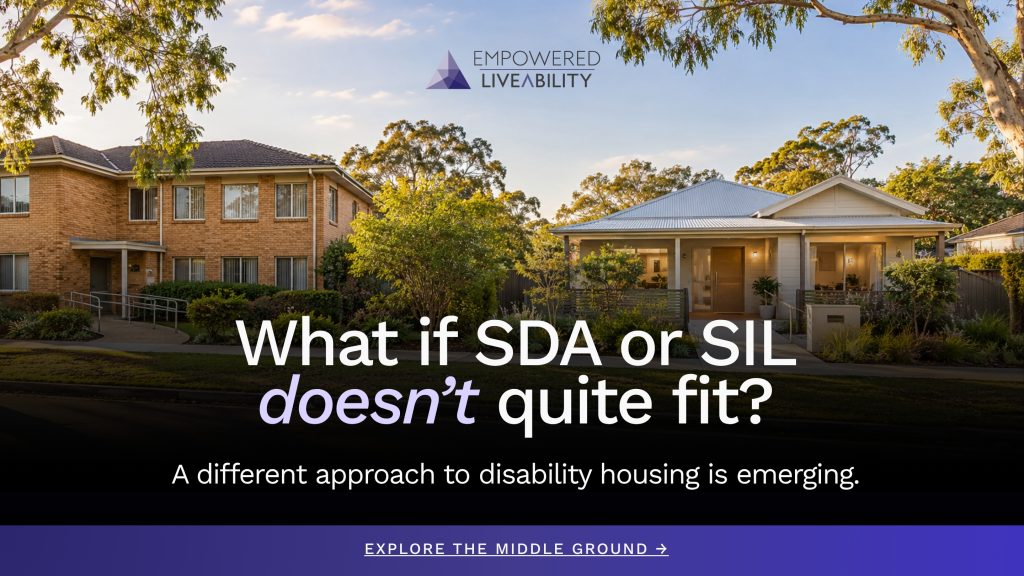
Creating a more flexible pathway between legacy housing and independent living.
For many people living with a disability, moving out of legacy housing is not as simple as choosing between a traditional shared living arrangement or living alone. The reality is some of these people may not fit neatly within the usual Supported Independent Living (SIL) or Specialist Disability Accommodation (SDA) pathways, yet still need an accessible home, regular support, and the reassurance of living alongside others in the communities that they are familiar with.
A hybrid housing model can help respond to this gap. It combines the privacy and independence of a contemporary shared home with the flexibility to accommodate residents who have different housing and support arrangements. The goal is not to create another institutional model. It is to offer a smaller, thoughtfully designed home in an established community, where each resident can receive the support that is right for them.
Understanding the gap
Across the sector, people continue to live in older group homes and other legacy settings without a clear pathway to a more contemporary housing option. Their needs may have changed, the property may no longer suit them, or the model itself may be transitioning. However, the alternatives available to them can be limited.
Some people do not require, or may not be funded for, the level of shared supports commonly associated with Supported Independent Living. They may also not meet the eligibility requirements for Specialist Disability Accommodation, which is intended for people with extreme functional impairment or very high support needs. That does not mean they can safely live without support, nor does it mean that an isolated one-bedroom apartment will suit their social, practical or emotional needs.
When housing pathways are treated as an either-or choice, this group risks being overlooked. A hybrid model recognises that independence exists on a spectrum. A person may be capable of managing many parts of daily life while still benefiting from accessible design, scheduled or responsive support, shared living, and the presence of trusted people nearby.
What a hybrid model can look like.
Hybrid housing is not a formal NDIS funding category. It is a way of designing and operating a home so it can respond to a broader range of residents and remain adaptable over time.
In practice, the model may involve a small shared home with private bedrooms and bathrooms, generous personal storage, accessible communal areas and features aligned with Improved Liveability design principles. A limited number of residents may have SDA funding, while others may live in the same home through a different tenancy or funding arrangement. The final mix depends on each person’s eligibility, preferences, compatibility and support plan.
Housing and support must still be considered separately. Every prospective resident requires an individual assessment, appropriate funding and a clear understanding of how their daily supports, overnight needs, safeguards and tenancy rights will be managed. The model works when the home adapts to its residents, rather than expecting residents to fit a predetermined service structure.
Independence without isolation.
A move from a larger legacy setting should create greater choice, privacy and control. It should not replace one unsuitable model with another form of disconnection.
For someone who has lived with other people for many years, moving suddenly into a single apartment may be deeply isolating. A smaller shared home can provide a better balance: residents have their own private space and greater control over daily routines, while still having opportunities for companionship and informal connection. Support can be available when it is needed without dominating the home.
This is particularly important for people who value familiar routines, benefit from predictable environments or need reassurance that another person is close by. Safety is not only about physical design. It can also come from knowing the neighbourhood, recognising local faces, understanding familiar transport routes and having trusted supports within reach.
Keeping people connected to their communities
Where a person lives shapes almost every part of their life. Medical and allied health appointments, work, day programs, shops, recreation, friendships, family relationships and community participation are often concentrated within a relatively small area. For people who do not drive, familiar public transport routes and local support networks can be essential to independence.
This is why establishing hybrid homes in communities where legacy housing already exists can be so valuable. It creates the possibility for people to move into a more suitable home without losing the relationships and local knowledge built over many years. Remaining near family, friends, health professionals, and familiar services can reduce disruption and make a transition safer and more sustainable.
A successful move should expand a person’s choices, not ask them to surrender their community in exchange for a better building.
Making more locations possible
Flexible design can also support the long-term viability of homes in established areas. Traditional SDA developments can carry significant vacancy and funding risk, which can make it difficult to attract housing investment in some locations. A property designed for more than one appropriate tenancy pathway may remain viable under different resident mixes and changing circumstances.
That flexibility can help make well-located homes possible in communities where people already live but where purpose-built disability housing is limited. The benefit for residents is access to established neighbourhoods with public transport, healthcare, shops and community infrastructure, rather than being pushed towards locations chosen only because land is cheaper or development is easier.
Financial sustainability matters because a housing pathway can only serve people if the homes can be built, maintained and retained for the long term. In a strong hybrid model, commercial viability supports the social purpose; it does not replace it.
What good implementation requires
A hybrid model is not simply a larger house with several unrelated tenants. Its success depends on careful planning, transparent governance and genuine person-centred decision-making. This includes matching residents thoughtfully, protecting privacy and tenancy rights, planning supports around each person, considering changing needs and ensuring the design is genuinely accessible for the intended residents.
It also requires collaboration between the person, their family or chosen supporters, housing provider, support providers, allied health professionals and funding bodies. No housing model should be presented as suitable for everyone, and no one should be placed into a shared home merely to fill a vacancy. Choice, compatibility, dignity and safety must remain central from the first conversation through to move-in and ongoing tenancy.
A pathway that leaves fewer people behind
As the disability housing sector moves away from outdated models, it must ensure that people are not left without a realistic next step. Progress cannot be measured only by closing legacy settings; it must also be measured by the quality, suitability and location of the homes people can move into.
The hybrid housing model offers one possible pathway for people who sit between existing options. It can provide privacy without isolation, support without unnecessary restriction and a safer transition without severing established community connections.
Most importantly, it begins with a simple principle: people should not have to fit a funding label before the sector is willing to imagine a home that fits their life.
