
How SDA and SIL providers can collaborate to create more appropriate housing pathways
Australia’s housing crisis is placing enormous pressure on people searching for a safe, suitable and affordable place to call home. For people with disability, that challenge can be even greater. A property may technically be available, but that does not necessarily mean it is accessible, appropriate, or capable of supporting a person’s independence.
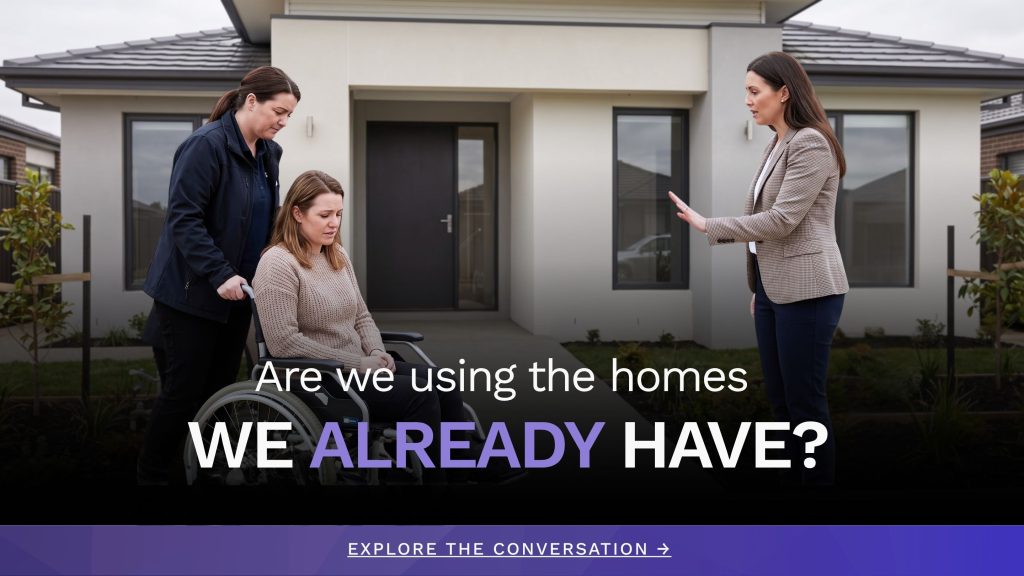
At the same time, there are accessible homes within some Specialist Disability Accommodation (SDA) markets that remain vacant while providers search for SDA-funded tenants. This raises an important question for our Home and Living sector: could we be making better use of the accessible housing that already exists?
Looking beyond an SDA decision, Supported Independent Living (SIL) providers work alongside many people with disability who need substantial day-to-day support but do not have SDA funding. Some may miss SDA eligibility by a narrow margin. Others may be navigating an application, review or change in circumstances.
Yet a person does not suddenly stop benefiting from accessibility because they do not have SDA in their plan. A mainstream rental may present narrow doorways, steps, inaccessible bathrooms, unsuitable kitchens, limited circulation space or environments that make it harder for support workers to assist safely. And landlords who may be reluctant to approve modifications in a home that really wasn’t designed with accessibility as a main purpose.
For the right participant, an existing accessible home may offer a far more functional housing option while supporting greater independence, safety and capacity.
This is where stronger relationships between SDA and SIL providers can make a meaningful difference by using the housing we already have.
Where an SDA provider has a suitable property sitting vacant, there may be opportunities to explore alternative leasing arrangements for participants who do not currently have SDA funding, where this is appropriate and consistent with the property’s funding, contractual and regulatory requirements.
For SIL providers, this can broaden the housing conversation beyond the mainstream rental market. Instead of trying to make an unsuitable property work for a participant, providers can ask whether accessible housing already exists within the communities where participants want to live.
There is also a wider benefit. At a time when rental supply is under extraordinary pressure, making appropriate use of existing accessible housing may help reduce unnecessary competition for mainstream rentals while ensuring specialised housing stock is not sitting unused.
An accessible home can also help us understand what works because accessible housing is about far more than ramps, wider doorways and accessible bathrooms. The right environment can change how someone moves through their day, completes everyday tasks, receives support and participates in their home and community.
Living in a more appropriate environment can provide valuable real-world information. Participants, families, allied health professionals, and support teams can better understand which design features improve safety, functional capacity, independence, and the delivery of supports.
For someone who later seeks SDA funding, this lived experience may contribute useful evidence about their functional needs and the housing features that make a measurable difference. It is important to be clear that living in an accessible property does not establish SDA eligibility; eligibility remains an individual NDIS decision supported by appropriate evidence. But lived experience can help turn hypothetical needs into practical, observable information.
So, what could this collaboration look like?
The opportunity is not simply for an SDA provider to supply a house and a SIL provider to fill it. The strongest outcomes come when both parties bring their expertise to the table while keeping the participant at the centre of every decision.
• Share vacancy information early. SDA providers can build relationships with SIL organisations before a vacancy becomes prolonged, sharing information about location, design category, accessibility features and the type of household the property may suit.
• Share functional knowledge. SDA providers understand accessible housing design; SIL providers understand the everyday support needs they see in practice. Bringing those perspectives together can help identify better housing matches.
• Create stronger referral pathways. Providers can connect participants, families, Support Coordinators and allied health professionals with appropriate housing options rather than allowing people to navigate the system in isolation.
• Support better evidence and planning. Where appropriate, both providers can contribute observations about how the environment affects independence, safety and support delivery, while leaving clinical and eligibility evidence to the relevant professionals and decisionmakers.
• Protect choice and control. Collaboration should create more options for participants, not fewer. Housing and support remain distinct, and participants should be supported to understand their choices and make informed decisions about where they live and who provides their supports.
SDA and SIL serve different purposes, and maintaining appropriate separation between housing and support is essential. But separation should never mean working in silos.
At Empowered Liveability, we believe some of the strongest outcomes happen when providers are willing to have the conversation, share what they know and look beyond the boundaries of their own service to consider the participant’s whole housing journey.
In the middle of a housing crisis, we should be asking whether every suitable home is being used as effectively as it can be. If accessible housing is available, and there is a participant whose life could be made safer, more independent and more connected by living there, that is a conversation worth having.
Because ultimately, the goal is not simply to fill a vacancy or secure a rental. It is to create sustainable housing pathways that give people with disability genuine choice about where, how and with whom they live.
