
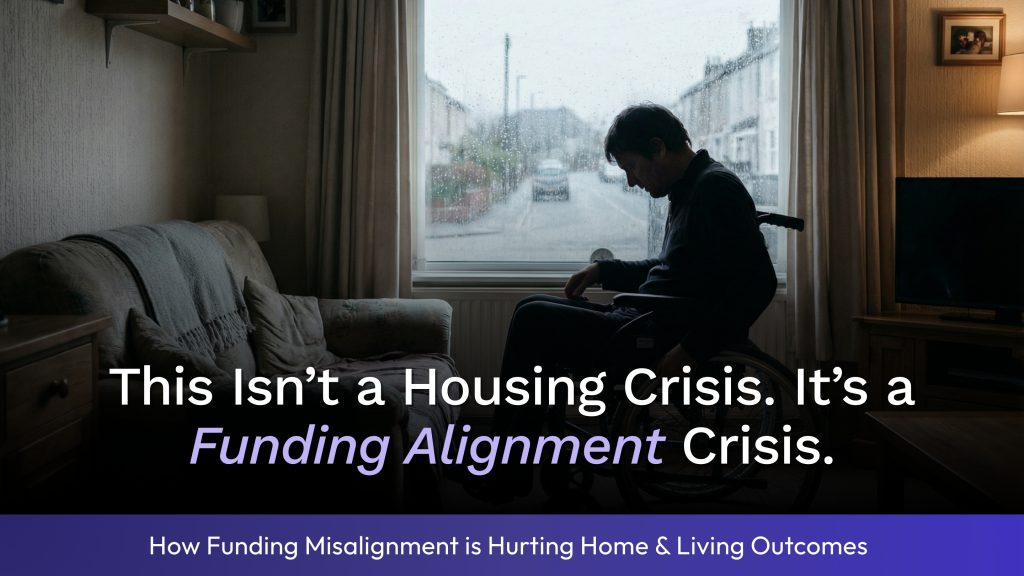
Across the NDIS, we’re seeing a growing gap between housing readiness and support readiness. To put it simply: a participant may have Specialist Disability Accommodation (SDA) approved (or an SDA option identified), but the plan doesn’t include enough day-to-day supports to make a move-in safe, stable, or sustainable.
The challenge this is creating is becoming sharper as planning and budgeting settings shift. The NDIA has flagged that “new framework planning” and support needs assessments will roll out from mid-2026, the aim being greater consistency and fairness in budgets. Alongside this, public reporting has raised concerns about participants’ ability to challenge the total funding amount externally under the new system.
This is of course causing a flow-on impact with hospital, crisis, and housing delays.
The community is already reading about and living through the consequences of funding misalignment. Recent reporting has highlighted families are under pressure with the growing uncertainty around plan changes, and the real-world impact of reductions or tighter interpretations of “reasonable and necessary” supports. We’ve also seen coverage of people who are medically ready for discharge but remain stuck in hospital due to insufficient funded supports to safely return home.
For SDA providers, this creates a downstream problem: a home can be available, appropriate, and funded yet still not be viable to occupy if the participant’s SIL, in-home nursing, active overnight support, or allied health hours aren’t funded at a level that matches the environment and risk profile.
So, why are SDA and SIL feeling it at the same time? These two sectors – housing and care supports – are designed to be complementary. But when budgets are set in ways that don’t reflect complexity, SIL providers can be left with “hands tied” leaving them unable to staff safely, retain skilled workers, or accept a transition that increases risk for everyone (participant, co-residents, and staff). In that moment, SDA vacancies can rise and move-ins stall, not because the housing market failed, but because the support ecosystem can’t safely activate the tenancy.
Which leads to the question, what can SDA providers do to prepare? To be proactive we have some suggestions around what SDA providers can put in place now before the next wave of planning changes lands:
1. Pre-move-in “Support Sufficiency Check” (standardised).
Build a simple, repeatable checkpoint with SIL partners and support coordinators: roster viability, active overnight needs, delegated clinical tasks, incident response, transport, and allied health frequency. If the plan can’t sustain it, flag it early.
2. Evidence packs that link housing design to funded support needs.
Many plans fail when the rationale is fragmented. Create templates that connect functional impact > risks > required supports > why the SDA design is necessary (and what happens without the right support hours).
3. Joint transition planning with clear “go/no-go” criteria.
Co-sign a transition plan with SIL and the care team that defines minimum staffing ratios, escalation pathways, and what triggers a pause. This protects participants from unsafe placements and protects providers from preventable failures.
4. Scenario planning for plan reassessments.
With new planning approaches coming mid-2026, run “what if” scenarios: if core hours drop by X, what changes in rostering, assistive tech, co-resident compatibility, and clinical oversight are required?
5. A shared escalation pathway when safety is compromised.
When funding is insufficient, delay becomes the safest option, but it shouldn’t be silent. Establish a documented process for urgent reviews, hospital discharge coordination, and risk communication so the participant isn’t left in limbo. (Public reporting suggests this limbo is already happening.)
The strongest outcomes happen when SDA + SIL + Support Coordination operate like a single transition team: shared information (with consent), shared timelines, shared risk frameworks, and a clear narrative to planners about why the housing solution fails without adequate supports. It’s not “housing versus supports” it’s housing plus supports equals safety.
If we want fewer failed transitions, fewer hospital readmissions, and fewer tragedies linked to preventable support gaps, we have to treat plan alignment as a front-end requirement, not a back-end surprise.
