
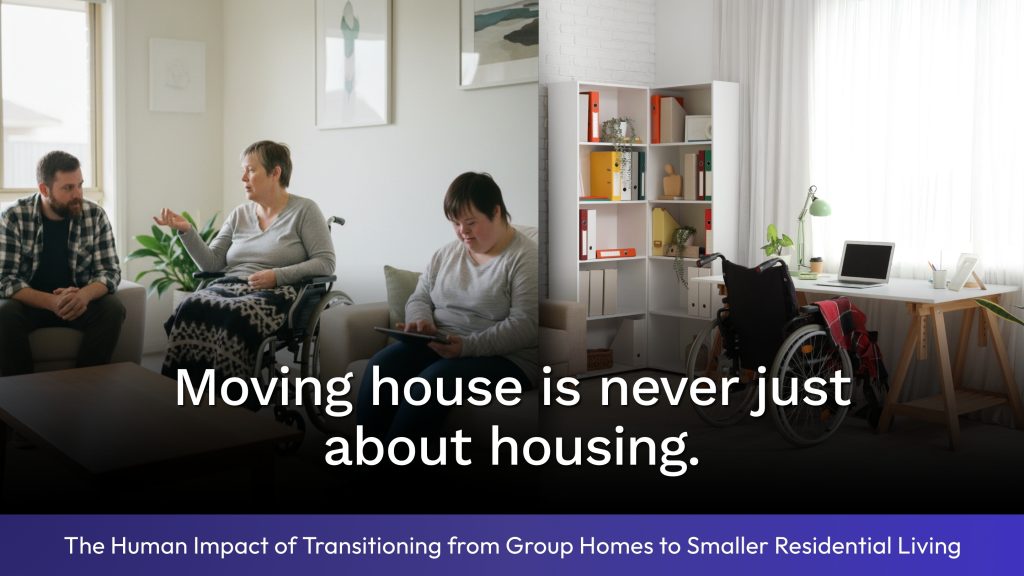
The transition from large group home models to smaller, more individualised residential settings is often spoken about in terms of policy, funding, and housing supply. Yet for participants, the experience is deeply personal and at times profoundly unsettling. Understanding why this transition can be challenging requires us, as providers, to look beyond logistics and recognise the emotional, psychological, and social layers involved. It demands sensitivity, compassion, and genuine understanding.
For many people with disability, group homes were not a lifestyle choice, but a placement decision made on their behalf. These large, multi-resident facilities sometimes housing 10 to 15 people or more became home not because they were ideal, but because they were familiar. Over years, and often decades, participants have built relationships, routines, and a sense of safety within these environments. Staff became trusted figures. Fellow residents became friends, sometimes the closest social connections a person has known for much of their adult life.
To expect participants with complex physical, cognitive, or psychosocial needs to “simply adjust” to a new home without acknowledging this history is not only unrealistic it’s unfair.
Consider for a moment what it was like when you first moved out of home. Even when the move was voluntary and positive, it likely came with a sense of unease. You were navigating a new neighbourhood, unfamiliar surroundings, different routines, and the loss of daily proximity to people you knew well. Things as simple as local shops, traffic flow, bin collection days, or mail delivery can take time to adjust to.
Now imagine experiencing that same upheaval without having chosen it while also managing disability-related support needs, communication barriers, or anxiety around change. For many participants, transitioning out of a long-term group home means leaving behind not just a building, but a way of life. Long-standing friendships may be fractured. Familiar staff may be replaced. Established routines sometimes relied upon for emotional regulation and stability can be disrupted overnight.
These changes can feel overwhelming, and in some cases, distressing.
This is why the way we approach transition matters just as much as the outcome. A move into a smaller residential setting or SDA property should never be treated as a simple relocation. It is a life transition, and it must be handled with care.
Wherever possible, maintaining geographic familiarity such as staying within the same community or region can help preserve connections and reduce anxiety. Gradual transitions, including staged staff changeovers or overlapping support teams, can significantly ease the stress associated with change. Most importantly, participants should be meaningfully involved in decisions about their housing and living arrangements, in ways that are accessible and respectful of their communication needs.
These insights come directly from Empowered Liveability’s Tenancy team own experience navigating this process. Our team works closely with providers supporting participants transitioning from group homes into SDA properties across their regions. Their experience reinforces a simple but powerful truth: successful transitions are not rushed, transactional, or one-size-fits-all.
When we centre the human experience acknowledging loss as well as opportunity, we create pathways to housing that are not only fit for purpose, but genuinely supportive of wellbeing, dignity, and choice.
